

The short answer
No. Berberine is not nature’s Ozempic, and if dramatic weight loss is the only thing you are after, the trial numbers below will talk you out of it. But the nickname is the least interesting thing about this compound, and the honest record underneath it is the reason this article exists.
But here is what the human trials actually found. A bitter yellow compound from the roots of plants like barberry and goldenseal was statistically indistinguishable from metformin on HbA1c in small, short head-to-head trials. Against placebo, it cut LDL cholesterol by about 18 mg/dL. In one early 48-person add-on trial, fasting insulin fell by 28.1% and insulin resistance by 44.7%. It did this by switching on AMPK, the same metabolic master switch your body flips when you exercise. And it costs roughly $30 to $45 a month at the doses the trials used, against roughly $1,000 a month at list price for the drug it is nicknamed after.
The nickname gets one thing right: millions of people are done being customers for life, and they are looking for what nature already built. It gets the mechanism, the magnitude, and the point wrong. So let us do this the way I do everything here, the same standard I applied to lion’s mane: what the research actually shows, every number sourced, the hype graded as hard as the compound itself. One promise before we start: the largest trial ever run on berberine and body fat is in this article, in full, and the nickname industry never quotes it. You will see why.
What is berberine?
Berberine is a bitter, bright yellow plant alkaloid found in the roots of plants like barberry and goldenseal. Modern science came to berberine late, and for a different reason: researchers kept measuring changes in blood sugar, cholesterol, and insulin that were too consistent to wave off.
That combination, ancient use plus measurable modern effects, is exactly why berberine deserves a serious look instead of either blind hype or an eye roll. It is not a vitamin. It is not a gentle wellness tea. It is a pharmacologically active plant compound, and the trial record behind it is larger than the one behind most supplements you will ever read about here.
How does berberine work in the body?
Start with the switch. Deep inside your cells sits an enzyme called AMPK, often described as the body’s master energy sensor. When energy runs low, AMPK flips on and gives a set of orders: pull more glucose out of the blood and into muscle, stop producing so much glucose in the liver, burn more fat, store less of it, and become more sensitive to insulin again. Exercise flips this switch. So does fasting. And in laboratory and animal studies, berberine flips it too (Lee et al., Diabetes, 2006; Turner et al., Diabetes, 2008).
Hold onto that, because it is the most important sentence in this article: metformin, the flagship blood sugar drug, is famous for working through this same pathway. The plant and the drug are pulling the same lever. That is the legitimate root of every comparison you have ever seen, and it is a comparison about blood sugar and metabolism, not about the weight-loss injections.
Berberine does not stop at one lever, and this is its genuinely unique property. One plant compound, several of the body’s own systems at once:
The cholesterol lever. In lab studies, berberine protected the message that builds LDL receptors in the liver and turned down PCSK9, the protein that destroys those receptors (Kong et al., 2004; Cameron et al., 2008). More receptors on duty means more LDL cholesterol pulled out of the blood. This mechanism is mapped, not folklore.
The gut lever. In the largest modern trial, berberine measurably reshaped the gut microbiome and cut the production of a bile acid called deoxycholic acid, and the researchers tied part of the blood sugar effect to that gut action (Zhang et al., Nature Communications, 2020).
The GLP-1 whisper. In cell and animal studies, berberine nudged gut cells to release more of the body’s own GLP-1, the hormone the famous injections imitate (Yu et al., Biochemical Pharmacology, 2015). Be precise about this, because precision is the whole game here: berberine does not bind the GLP-1 receptor the way Ozempic does, and the gut hormone effect has never been proven to matter in a human trial. It is a whisper next to a pharmaceutical shout. Anyone who tells you otherwise is selling you something.
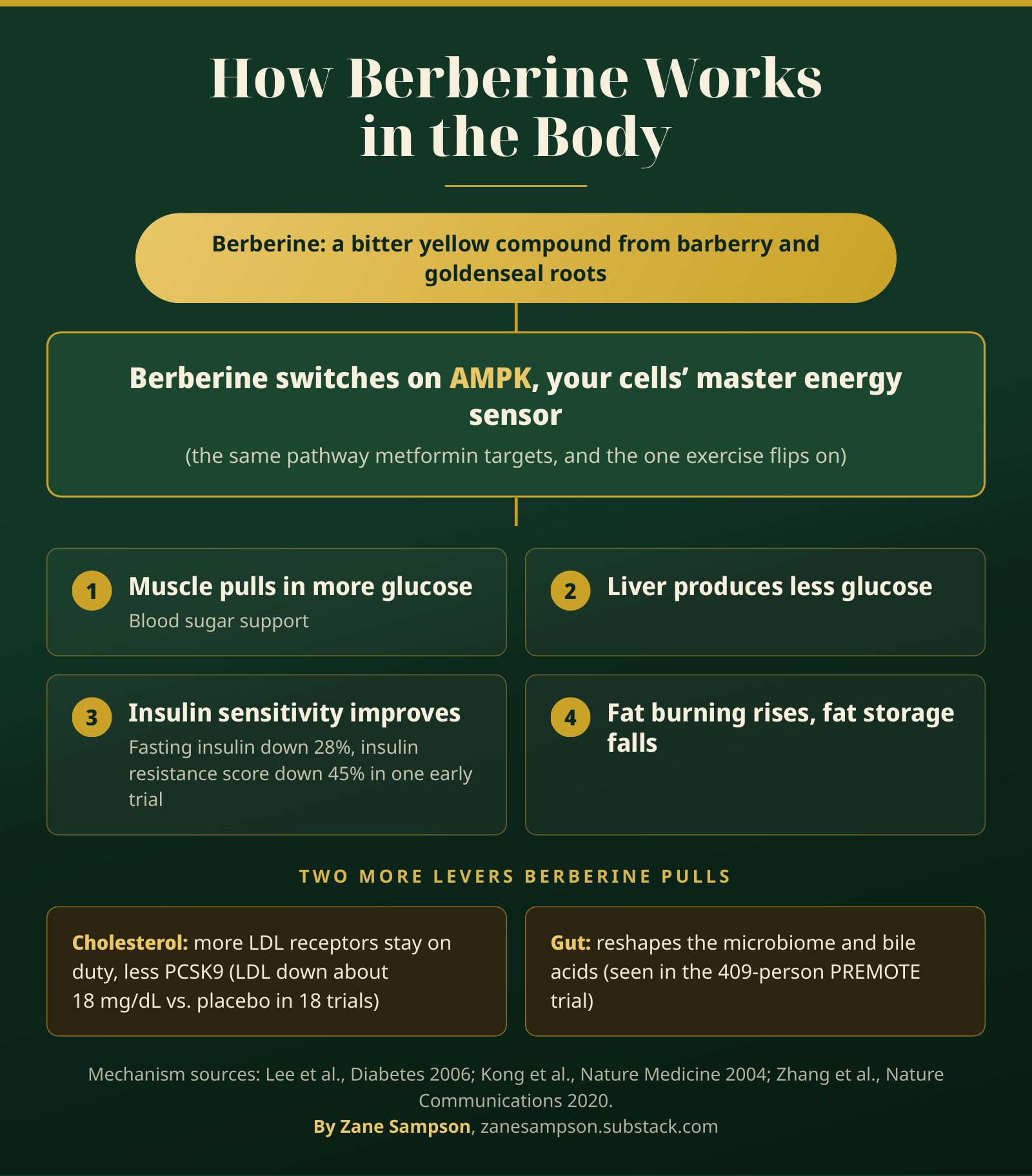
Berberine’s central pathway is AMPK activation, with additional effects on cholesterol handling and the gut.
What do the human trials actually show about blood sugar?
This is berberine’s real lane, and the record is stronger than most people on either side of the argument realize.
Across 37 randomized trials and 3,048 patients with type 2 diabetes, berberine lowered HbA1c (A1C), the three-month blood sugar average, by about 0.63 percentage points versus control, and fasting glucose by about 15 mg/dL (Xie et al., Frontiers in Pharmacology, 2022). A stricter analysis of berberine alone, without other drugs in the mix, put the HbA1c effect closer to 0.45 points (Ye et al., Frontiers in Pharmacology, 2021). So the honest range is about half a point, give or take, and I will take honest ranges over cherry-picked peaks every time.
The best modern trial makes the point best, precisely because it flatters nobody. In PREMOTE, a double-blind, placebo-controlled study of 409 people published in Nature Communications, berberine at 0.6 grams twice a day lowered HbA1c by 0.99 points in 12 weeks. Impressive, until you see the placebo group dropped 0.59 points from the trial itself: a one-week antibiotic run-in before treatment began, new attention to food, and being watched. The benefit that belongs to berberine itself is about 0.4 points beyond placebo. That is a real effect, in the range of a modest oral diabetes drug, from a plant alkaloid. It does not need exaggeration. It is interesting enough at its true size.
And the study that started all of this: in a small 2008 pilot, 36 newly diagnosed patients were split between berberine and metformin at the same dose, 500 mg three times daily. After three months, the berberine group’s HbA1c had fallen from 9.5% to 7.5%, a drop the researchers themselves described as similar to metformin’s (Yin et al., Metabolism, 2008). It was a pilot, with no placebo group, and I am flagging that before anyone else can. But it is the reason scientists took this compound seriously, and eighteen years of trials since have not erased it.
It was not a one-off. That same year, a placebo-controlled trial of 116 people with type 2 diabetes and high cholesterol put berberine at 1 gram a day for three months and found significant reductions versus placebo across fasting glucose, after-meal glucose, HbA1c, triglycerides, total cholesterol, and LDL (Zhang et al., Journal of Clinical Endocrinology & Metabolism, 2008).
The pricing machine behind all of this, the system that turned a $1 insulin patent into a drug people ration to survive, is the other half of the story, and I told it in how a $1 insulin patent became a $280 drug Americans ration to survive. Here we stay on the compound itself: what it does, what it cannot do, and how to judge it like an adult.
If this standard, every claim graded and every number sourced, is what you want applied to the next supplement headline, get these breakdowns free and first:
Does berberine improve insulin resistance?
Yes, and this may be its most underappreciated benefit, because insulin resistance is the slow fire underneath almost every metabolic problem my readers write to me about.
In the second arm of that 2008 pilot, 48 people with poorly controlled blood sugar added berberine to their existing routine. In three months, their fasting insulin fell by 28.1% and their insulin resistance score, HOMA-IR, fell by 44.7% (Yin et al., Metabolism, 2008). Pooled across dozens of later trials, the effect holds at a more modest but consistent level: HOMA-IR improvements of roughly 0.7 to 1.0 points (Guo et al., Oxidative Medicine and Cellular Longevity, 2021; Zamani et al., Frontiers in Nutrition, 2022).
Plain English: berberine does not just lower the glucose number. In trial after trial, it helped the body need less insulin to do the same job. That is the AMPK switch doing exactly what it is supposed to do, and for a reader watching their fasting insulin creep up year after year, it is the benefit that matters most.
Does berberine lower cholesterol?
Yes, and here the evidence is placebo-controlled and clean. Across 18 randomized placebo-controlled trials and 1,788 adults, berberine lowered LDL cholesterol by about 18 mg/dL and triglycerides by about 30 mg/dL compared to placebo (Blais et al., Drugs, 2023). The researchers themselves called these “small reductions,” and they were right to. But small is not nothing, especially stacked on top of the blood sugar effects, and especially when you remember the mechanism: this is the LDL receptor and PCSK9 work from the Nature Medicine paper showing up in human bloodwork, just as the lab studies said it should.
One more data point worth your attention, because it comes from the toughest trial in this entire article. In BRAVO, a large, rigorous 2026 trial in JAMA Network Open, LDL cholesterol fell by about 8 mg/dL, and apolipoprotein B, the particle count cardiologists increasingly watch, improved too (Lei et al., JAMA Network Open, 2026). Remember that trial. It does not flatter berberine at all.
Berberine vs. Ozempic: does berberine work for weight loss?
For weight loss, berberine works only slightly. Across trials it produced about 1 to 2 kg over roughly three months, and the largest rigorous fat trial found no reduction in visceral or liver fat versus placebo. Semaglutide and tirzepatide produced 14.9% and up to 20.9% body-weight loss in their landmark trials. Here is where I have to be the friend who tells you the truth instead of the influencer who tells you what sells.
Across the weight trials, berberine produces about 1 to 2 kilograms of weight loss over roughly three months, call it 2 to 4.5 pounds, mostly in people with diabetes or metabolic syndrome (Asbaghi et al., Clinical Nutrition ESPEN, 2020; Elahi Vahed et al., International Journal of Obesity, 2026). The US National Center for Complementary and Integrative Health reviewed the same literature and concluded: “Some studies suggest that it might, but the evidence is not conclusive.”
Now the drugs. In their landmark trials, semaglutide (Ozempic and Wegovy) produced 14.9% body weight loss over 68 weeks, and tirzepatide reached 20.9% over 72 weeks (Wilding et al., New England Journal of Medicine, 2021; Jastreboff et al., New England Journal of Medicine, 2022). On a 220-pound person, that is roughly 33 to 46 pounds, against berberine’s 2 to 4. It is not a gap. It is a different universe.
And the hardest evidence of all: BRAVO, the largest and most rigorous berberine trial ever run on fat, put 337 adults with obesity and fatty liver on 1 gram a day for six months. Berberine did not reduce visceral belly fat or liver fat any more than placebo (Lei et al., JAMA Network Open, 2026). The one trial designed to test the nickname’s core promise came back null on fat itself.
So no, berberine is not a weight-loss drug, natural or otherwise, and the people who named it “nature’s Ozempic” were selling the one benefit it barely has. Read that again, because it is the sentence the nickname industry hopes you skip: the nickname advertises berberine’s weakest effect and ignores its strongest ones. Blood sugar, insulin sensitivity, cholesterol: real, measured, replicated. Fat loss: a rounding error wearing a headline.
Why do the drugs win so completely on weight? Because they do something berberine never claimed to do until marketers claimed it for it. They force a gut hormone signal at pharmaceutical strength, around the clock, and appetite shuts down whether the person wants it to or not. That power comes with the trade anyone can read in the trial reports: nausea hit 44% of the semaglutide trial group, and when the injections stop, about two-thirds of the lost weight comes back within a year (Wilding et al., New England Journal of Medicine, 2021; Wilding et al., Diabetes, Obesity and Metabolism, 2022), the bill runs about $1,000 a month at list price (Novo’s own cash price is $349 a month as of late 2025), and you are a subscriber to a drug for life. Some people judge that trade worth making. My readers get to judge it with the numbers in front of them, which is more than the marketing on either side usually allows.
Berberine vs. metformin: how do they really compare?
Because they share the AMPK pathway, this is the comparison that actually matters, and the head-to-head data is genuinely interesting. Pooled across the trials that put them directly against each other, berberine and metformin were statistically indistinguishable on HbA1c, with a difference of just 0.17 points that did not reach significance. And in the same analysis, taking berberine alongside metformin beat metformin alone by about 0.65 points of HbA1c (Wang et al., Health, 2021).
That combination result is a trial finding, not a recommendation to stack the two. ANSES advises against combining berberine supplements with drug treatment, including metformin, because berberine can change drug metabolism and add to glucose lowering. Anyone taking metformin should treat adding berberine as a medication decision, not a casual add-on.
The pattern held in a small 2025 trial run in people with prediabetes rather than diabetes: berberine and metformin at the same 500 mg three times daily produced nearly identical HbA1c drops over 12 weeks, and gut complaints ran lower on berberine, 20% of users versus 30% (International Journal of Basic & Clinical Pharmacology, 2025).
Now the discipline, because this is exactly where supplement marketing usually lies to you by omission. Those head-to-head trials were small, short, about 12 weeks, and run almost entirely in China. Berberine has never beaten metformin in a trial. And metformin carries something berberine does not have and cannot borrow: decades of long-term outcome data, including evidence on the complications that actually hurt people. Berberine’s entire record is blood markers measured over weeks and months. Comparable on a 12-week blood sugar chart is a real and remarkable finding for a plant compound. It is not the same as proven equal over a lifetime, and nobody honest will tell you it is.
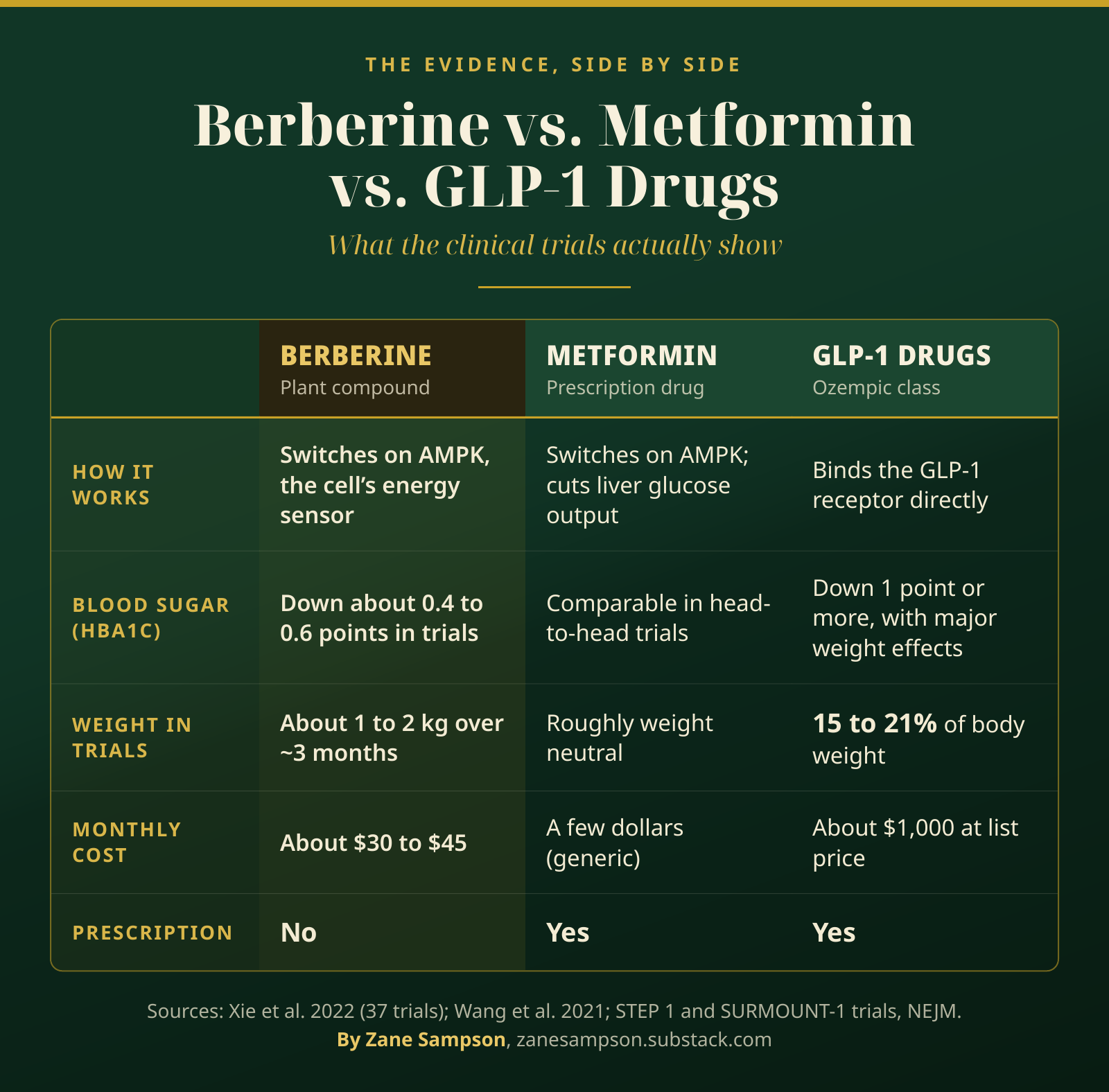
How it works. Berberine: Activates AMPK, the cell’s energy switch; also supports the body’s own GLP-1 release in lab studies. Metformin: Activates AMPK; reduces glucose production in the liver. GLP-1 drugs (Ozempic class): Binds the GLP-1 receptor directly at pharmaceutical strength.
HbA1c effect in trials. Berberine: About 0.4 to 0.6 points. Metformin: Comparable in head-to-head trials. GLP-1 drugs (Ozempic class): Larger, with major weight effects.
Weight effect in trials. Berberine: About 1 to 2 kg over ~3 months. Metformin: Roughly weight neutral. GLP-1 drugs (Ozempic class): 15 to 21% of body weight.
Long-term evidence. Berberine: Short trials only; no long-term outcome data. Metformin: Decades of long-term outcome data. GLP-1 drugs (Ozempic class): Large trials lasting 68 to 72 weeks for the cited weight studies.
Cost. Berberine: About $30 to $45/month. Metformin: A few dollars/month generic. GLP-1 drugs (Ozempic class): About $1,000/month at list; $349/month manufacturer cash price.
Prescription. Berberine: No. Metformin: Yes. GLP-1 drugs (Ozempic class): Yes.
What are berberine’s side effects, and who should skip it?
The common side effects are digestive: nausea, cramping, bloating, constipation, and diarrhea. The serious concern is interactions, because berberine slows CYP3A4, CYP2D6, and CYP2C9, three liver enzyme systems that clear many prescription drugs. Berberine is a hard no during pregnancy, while breastfeeding, and for infants, and safety beyond short trials is unknown.
I champion this compound, and I am going to give you its risks at full strength, because a plant molecule that can change your blood sugar and your cholesterol is, by definition, strong enough to change other things too. Respecting that strength is not a reason to fear berberine. It is the reason to use it intelligently, the way you would respect anything in nature that actually works.
It interacts with real medications. In a human study, two weeks of berberine measurably slowed three of the liver enzyme systems, CYP3A4, CYP2D6, and CYP2C9, that clear a long list of prescription drugs (Guo et al., European Journal of Clinical Pharmacology, 2012). In transplant patients, berberine raised blood levels of the immune-suppressing drug cyclosporine by a measured margin (Wu et al., European Journal of Clinical Pharmacology, 2005). France’s food safety agency, ANSES, reviewed the evidence and formally advises against combining berberine supplements with drug treatment, naming interactions with drugs including cyclosporine, tacrolimus, digoxin, certain statins, and metformin itself. My plain-English translation: if you take prescription medication, especially anything for your heart, your immune system, or blood thinning, berberine is a real decision, not a casual add-on. That is what potency means. A compound too weak to interact with anything would also be too weak to help you.
The gut effects are the common cost. Nausea, cramping, bloating, constipation, and diarrhea are the typical complaints. In the placebo-controlled cholesterol trials they appeared in 2 to 23% of berberine users versus 2 to 15% on placebo, and in the roughest early trial about a third of users had temporary gut trouble. Starting low and taking it with food is the pattern the dosing summaries describe for keeping those complaints manageable.
Pregnancy, breastfeeding, and infants are a hard no. Berberine can push bilirubin up in infants, and bilirubin buildup in a newborn’s brain is a serious harm. This is the National Center for Complementary and Integrative Health’s clearest warning on the compound, and it is absolute.
Nobody knows the long term, and anyone who says otherwise is guessing. Nearly every trial ran 24 weeks or less. There are no multi-year safety studies, no trials showing berberine prevents a heart attack, a stroke, or any other hard outcome. Every benefit in this article is a blood marker or a scale reading. I believe the marker evidence is strong enough to matter. I will not pretend it is more than it is.
And one boundary that is not negotiable in anything I write: berberine is a dietary supplement. It is not approved to treat any disease, and it is not a replacement for insulin or for medication someone depends on. The trials show what it adds. They do not show it safely substituting for the treatment of a diagnosed disease, and this article will never claim otherwise.
What berberine dosage did the trials use? Forms and absorption
If you read nothing else in this section, take this: nearly everything we know comes from one simple pattern. 500 mg, three times a day, with meals, for 8 to 16 weeks is the dominant protocol across the 37-trial record, with most trials landing between 900 and 1,500 mg per day in total. PREMOTE used 600 mg twice daily before meals. BRAVO used 500 mg twice daily. The dose gets split through the day because berberine clears the body in a matter of hours. One dose-response analysis pooling the trials put the most efficient dose near 1 gram a day for cholesterol, triglycerides, and weight (Zamani et al., Frontiers in Nutrition, 2022).
Then there is the problem my longtime readers already know by heart, because it is the same absorption problem I broke down with curcumin: berberine is absorbed terribly. Less than 1% of a dose reached the bloodstream in animal studies, and human reviews put the absorbed share at 5% or less. The gut pumps much of it back out, and the liver breaks down much of what gets through. And yet the trials still show effects, which is part of why researchers suspect so much of berberine’s work happens in the gut itself, where concentrations are high, and in the liver, where animal studies measured levels about ten times higher than in the blood.
Berberine HCl vs. phytosome and dihydroberberine. That absorption problem created a market of upgraded forms, and here is the honest state of play. Dihydroberberine, a converted form the gut absorbs more readily, produced far higher blood levels than standard berberine in exactly one human pilot, with five participants (Moon et al., Nutrients, 2021). Five people is a hint, not a verdict. Berberine phytosome, a form bonded to phospholipids, reached higher blood levels from less than half the dose in a 12-person study run by the ingredient’s own manufacturer (Petrangolini et al., 2021). No study anywhere shows an upgraded form produces better results in the body than the plain form, only higher blood levels. And here is the point almost nobody makes: the entire clinical record, every blood sugar and cholesterol number in this article, was built on plain berberine, the poorly absorbed form, at plain-form doses. Judge the fancy forms accordingly.
What I look for before I trust a berberine product
After ten years around this industry, I judge every supplement by standards before brands, the same sourcing and third-party testing standard I apply to everything I recommend. For berberine, the checklist is specific:
The dose on the label matches the dose in the trials. The studied range is 900 to 1,500 mg per day, split across the day with meals, and the label should say so plainly. A capsule dusted with 200 mg of berberine inside a long ingredient list is decoration, not the studied compound.
The form is disclosed. Plain berberine HCl is the form with the trial record. If a product uses an enhanced form, it should say so and say how much elemental berberine you actually get.
No proprietary blend hiding the amount. If the label will not tell you how much berberine is in it, the label is telling you something else.
Third-party testing. Berberine is not pre-approved or purity-checked by any regulator before it reaches a shelf, a gap researchers reviewing the weight trials flagged themselves. Independent testing is the only verification that exists, so it is not optional.
A company that answers for its product. Real contact routes, real sourcing answers, no miracle language on the bottle.
If you take prescription medication, reread the limits section above before you order anything, from anyone. That is not me hedging. That is me respecting a compound that is genuinely strong enough to matter.
The berberine I point readers to, because it meets that checklist, is Ascent Nutrition’s Berberine Complex: 1,000 mg of berberine per serving from Berberis aristata, the plain form the entire trial record was built on, with the dose stated plainly on the label, nothing hidden behind a blend. Use code ZANE10 for 10% off. I earn a commission when you buy through my links, and I would rather tell you that plainly, here, than bury it, because the trust is the entire business.
Sources
Lee YS, et al. Berberine activates AMP-activated protein kinase with beneficial metabolic effects. Diabetes, 2006.
Turner N, et al. Berberine and dihydroberberine inhibit mitochondrial respiratory complex I. Diabetes, 2008.
Kong W, et al. Berberine is a novel cholesterol-lowering drug working through a unique mechanism distinct from statins. Nature Medicine, 2004.
Cameron J, et al. Berberine decreases PCSK9 expression in HepG2 cells. Atherosclerosis, 2008.
Yu Y, et al. Berberine induces GLP-1 secretion through activation of bitter taste receptor pathways. Biochemical Pharmacology, 2015.
Yin J, Xing H, Ye J. Efficacy of berberine in patients with type 2 diabetes mellitus. Metabolism, 2008.
Zhang Y, et al. Treatment of type 2 diabetes and dyslipidemia with the natural plant alkaloid berberine. Journal of Clinical Endocrinology & Metabolism, 2008.
Zhang Y, et al. Gut microbiome-related effects of berberine and probiotics on type 2 diabetes (the PREMOTE study). Nature Communications, 2020.
Xie W, et al. Glucose-lowering effect of berberine on type 2 diabetes: a systematic review and meta-analysis (37 RCTs, 3,048 patients). Frontiers in Pharmacology, 2022.
Ye Y, et al. Efficacy and safety of berberine alone for several metabolic disorders. Frontiers in Pharmacology, 2021.
Guo J, et al. The effect of berberine on metabolic profiles in type 2 diabetic patients. Oxidative Medicine and Cellular Longevity, 2021.
Zamani M, et al. The effects of berberine supplementation on cardiovascular risk factors in adults. Frontiers in Nutrition, 2022.
Wang L, et al. Berberine and metformin in the treatment of type 2 diabetes mellitus. Health, 2021.
Berberine versus metformin in newly diagnosed prediabetes: a randomized comparative trial. International Journal of Basic & Clinical Pharmacology, 2025.
Blais JE, et al. Overall and sex-specific effect of berberine for dyslipidemia: 18 placebo-controlled RCTs. Drugs, 2023.
Asbaghi O, et al. The effect of berberine supplementation on obesity parameters. Clinical Nutrition ESPEN, 2020.
Elahi Vahed S, et al. The effect of berberine on obesity indices: 23 trials. International Journal of Obesity, 2026.
Lei L, et al. Berberine and adiposity in diabetes-free individuals with obesity and MASLD (the BRAVO trial). JAMA Network Open, 2026.
Wilding JPH, et al. Once-weekly semaglutide in adults with overweight or obesity (STEP 1). New England Journal of Medicine, 2021.
Jastreboff AM, et al. Tirzepatide once weekly for the treatment of obesity (SURMOUNT-1). New England Journal of Medicine, 2022.
Wilding JPH, et al. Weight regain and cardiometabolic effects after withdrawal of semaglutide: the STEP 1 trial extension. Diabetes, Obesity and Metabolism, 2022.
Aronne LJ, et al. Continued treatment with tirzepatide for maintenance of weight reduction in adults with obesity: the SURMOUNT-4 randomized clinical trial. JAMA, 2023.
Guo Y, et al. Repeated administration of berberine inhibits cytochromes P450 in humans. European Journal of Clinical Pharmacology, 2012.
Wu X, et al. Effects of berberine on the blood concentration of cyclosporin A in renal transplanted recipients. European Journal of Clinical Pharmacology, 2005.
Moon JM, et al. Absorption kinetics of berberine and dihydroberberine: a randomized crossover pilot trial. Nutrients, 2021.
Petrangolini G, et al. Berberine phytosome absorption in healthy volunteers. Evidence-Based Complementary and Alternative Medicine, 2021.
ANSES. Opinion on berberine-containing plants in food supplements. French Agency for Food, Environmental and Occupational Health & Safety, 2019.
National Center for Complementary and Integrative Health. Berberine and Weight Loss: What You Need To Know. Updated November 2023.
Quick answers
Does berberine really work like Ozempic?
No. Ozempic binds the GLP-1 receptor directly at pharmaceutical strength. Berberine does not touch that receptor. In cell and animal studies it nudges the gut to release a little more of the body’s own GLP-1, and its real pathway is different: it activates AMPK, the metabolic switch it shares with metformin. The overlap is marketing. The mechanisms are not the same.
Is berberine as effective as metformin for blood sugar?
In the small, short trials that compared them directly, their HbA1c effects were statistically indistinguishable, and combining them beat metformin alone by about 0.65 points. But berberine has never beaten metformin, the trials ran about 12 weeks, and metformin has decades of long-term outcome data that berberine simply does not have. Comparable on short-term blood sugar is the honest claim. Nothing more. That trial result is not a recommendation to combine them; berberine can interact with medicines, including metformin.
Does berberine reduce belly fat or liver fat?
In the largest and most rigorous test, no. BRAVO put 337 adults with obesity and fatty liver on 1 gram of berberine a day for six months, and visceral belly fat and liver fat did not improve any more than with placebo. Cholesterol still improved in that same trial. If a headline sells berberine as a belly-fat fix, it is selling the one claim the best trial tested directly and did not find.
How much berberine did the clinical trials use?
Most trials used 500 mg three times a day with meals, 1,500 mg per day in total, with the overall range across studies running 900 to 1,500 mg per day for 8 to 16 weeks. The best modern trial, PREMOTE, used 600 mg twice daily. Splitting the dose matters because berberine clears the body within hours.
How long do people take berberine in the studies, and is it meant to be forever?
The studies ran 8 to 16 weeks, with the longest rigorous trial at six months. There are no multi-year trials of safety or benefit, so nobody can honestly tell you what years of daily use does. The trial pattern is a defined stretch with measurements, not an open-ended lifetime habit adopted on faith.
What are berberine’s side effects and drug interactions?
The common effects are digestive: nausea, cramping, bloating, constipation, or diarrhea. The serious consideration is interactions. Berberine measurably slows liver enzymes (CYP3A4, CYP2D6, CYP2C9) that clear many prescription drugs, and it raised cyclosporine levels in transplant patients. France’s safety agency advises against combining it with drug treatment. It should never be used in pregnancy, breastfeeding, or for infants. Starting lower and taking it with food is the usual pattern for reducing digestive trouble.
Why is berberine’s absorption a problem, and what is berberine phytosome?
Very little of a standard dose reaches the bloodstream, under 1% in animal studies and 5% or less by human review estimates, because the gut pumps it back and the liver breaks it down. Phytosome and dihydroberberine forms raise blood levels in very small early studies, but no study shows they produce better results than the plain form, and the entire clinical record was built on plain berberine.
Is berberine a replacement for insulin or diabetes medication?
No, unambiguously. Berberine is a dietary supplement with real, moderate effects on blood sugar markers in trials. It is not approved to treat any disease, it has no long-term outcome data, and nothing in the research supports swapping it for insulin or prescribed medication. What the evidence supports is a studied metabolic tool, judged on its actual record. Nothing in the evidence supports treating it as a swap.
Related reading:
I’m Zane Sampson. I spent 10+ years in the natural health world, across retail, brand work, and consulting, and I write about food labels, supplements, and the claims the wellness industry makes, so you can judge them with the evidence in front of you. If this breakdown saved you from a hype purchase, or pointed you at a compound actually worth your money, subscribe so you don’t miss the next one. And tell me below: are you looking at berberine for blood sugar, for cholesterol, or because someone sold you the nickname? The answers shape the next deep dive.
Know someone who was sold the nickname? Send them this instead. The numbers make a better gift than the hype did.
P.S. The nickname “nature’s Ozempic” is not an accident. It is fear and hope, packaged by people who profit when you stop asking questions. I wrote SOLD ON FEAR about exactly that machine: how the wellness industry turned fear into a business model, and how to take your mind back. It is $22.22, and it will change how you read every label, headline, and miracle claim from here on.
Affiliate disclosure: I am an affiliate for Ascent Nutrition and earn a commission on purchases made through my links, at no extra cost to you. Code ZANE10 takes 10% off. I recommend products I judge against the standards in this article, and I disclose the relationship every time.
Read any label in 30 seconds.
The free Label Decoder is the one-page tool I use on every product claim. Join the newsletter and it is yours.
The book behind this work
SOLD ON FEAR is my book on how the wellness industry profits from fear, and how to see through it.